
Eastland County Court Records After Arrest
An Eastland County arrest creates more than one record track. The sheriff or arresting agency creates the custody side first, and the Eastland County Jail records the booking event. The formal court record starts when the prosecutor files a complaint, information, indictment, or other charging paper in the proper court. For felony matters, the county identifies the 91st District Court as the local trial court with felony criminal jurisdiction. The Eastland County Criminal District Attorney represents the State in district court and lower courts, using authority tied to Texas Government Code Section 44.167.
The booking side and the court side often use different words because they serve different jobs. Jail custody records may list arrest charges and hold reasons. Court records after a jail arrest show the charge chosen for prosecution, the court case number, bond orders, hearings, attorney filings, warrants or capias activity, pleas, dismissal orders, and judgments. Custody and booking details fit better on the Eastland County jail inmate records page, while photo questions fit the Eastland County jail mugshots page.
The District Clerk keeps district court records, party indexes, judgments, executions, and returns. That office is the key local records custodian when a felony case is filed in district court. The county also links public users to the Eastland County Tyler Self-Service portal, iDocket for county court and probate index information, and re:SearchTX as a statewide court-record search option. Those tools can help, but the county-linked portal warns that data may change without notice.
Find Court Records After Eastland Arrest
The best search path starts with identifiers from the jail record. Use the person's full name, booking date, arresting agency, and any cause number or warrant number the jail can confirm. Eastland County does not publish a normal browser jail roster in the reviewed pages, so the sheriff and jail pages route custody checks through the Eastland County Sheriff TX mobile app and the jail phone line. Once a case number is available, court records after a jail arrest become much easier to match in the clerk or portal systems.
- Confirm the booking through the Eastland County Sheriff TX app or by calling Eastland County Jail at (254) 629-3899.
- Ask whether a court case number, cause number, warrant number, or court assignment has been added to the custody record.
- Search Tyler Self-Service by party name, case number, or date range, accepting the portal disclaimer if required.
- Check re:SearchTX if the local portal does not show the case or if statewide court participation is relevant.
- Contact the District Clerk for district-level cases, or confirm the correct lower court if the charge is not filed in district court.
The official Texas DPS Criminal History Conviction Name Search is a separate paid statewide conviction search. It is not the same as a pending Eastland County court docket. DPS may help when the question is whether a conviction exists, but it will not replace the District Clerk record for pending charges, hearings, bonds, or recent filings.
The Eastland County District Court page shows the local court context for felony prosecutions.
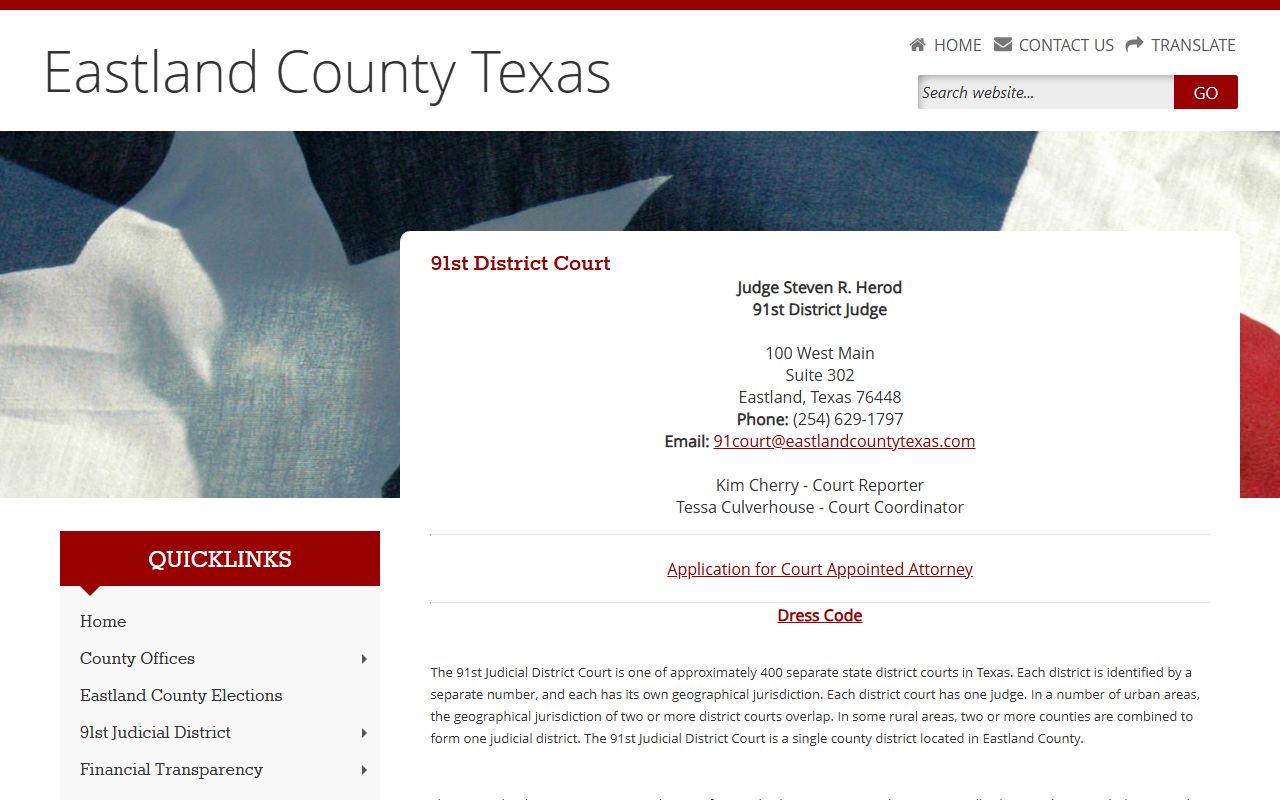
That court page helps separate a jail arrest from the felony court case that may follow it.
Eastland County Court Search Fields
Eastland County court record searches depend on the portal and court type. The county-linked Tyler portal is useful for local index searching, while re:SearchTX is a statewide court-record system. A search by name can work, but a case number is cleaner because common names, initials, spelling variants, and delayed filings can hide the correct record. If the portal shows no result soon after booking, that does not always mean charges were rejected. The prosecutor may not have filed yet, or the case may belong to a lower court, municipal court, justice court, or a restricted record category.
| Portal | Field | Use | Notes |
|---|---|---|---|
| Tyler Self-Service | Name / Party | Defendant search | Use last and first name, then narrow with date if needed. |
| Tyler Self-Service | Case Number | Precise case lookup | Best when the jail, clerk, citation, or indictment gives a number. |
| Tyler Self-Service | Date Range | Filing window | Use the booking month or likely filing month. |
| re:SearchTX | Party / Case | Statewide court lookup | Registration or login may be needed for some documents. |
| DPS Criminal History | Name and DOB | Conviction search | Requires account and credits; not a live jail or docket portal. |
Charges Filed After Arrest
Charges in court records after an Eastland County arrest come from a charging document. The words on that filing may differ from the words shown at jail booking. Police may book on a broad arrest charge, then the Criminal District Attorney reviews reports and chooses how, where, and whether to file. Felony cases commonly move through the 91st District Court path. Misdemeanor, citation, municipal, or justice-court matters may follow a different local route, so the court assignment matters as much as the charge name.
| Document | Who Uses It | What It Does |
|---|---|---|
| Complaint | Officer or prosecutor | States an accusation and may start or support a criminal case. |
| Information | Prosecutor | Formal charge filed by the State without a grand jury indictment. |
| Indictment | Grand jury | Formal felony charge returned after grand jury review. |
The first charge paper is not the final outcome. Prosecutors can amend, reduce, add, or dismiss charges as evidence develops. A court record may also show bond conditions, counsel appointment, motions, warrant returns, plea settings, trial settings, or judgment entries. For Eastland County court records after a jail arrest, the most reliable reading comes from matching the charge document to the current case status, not relying on the booking label alone.
Eastland Charge Status Records
A charge status tells where the case sits. The status is not the same thing as custody status. A person may be released from Eastland County Jail while the charge remains pending, or may stay in jail because of a hold even after one charge changes. Court records after an arrest should be read with bond records and custody records side by side when release timing matters.
| Status | What It Means | Where to Check |
|---|---|---|
| Pending | The charge remains open and has not reached final disposition. | District Clerk, court docket, or portal. |
| Amended | The State changed the charge wording, count, or level. | Case docket and filed charging documents. |
| Reduced | The charge level or offense may have been lowered by filing or plea. | Court order, plea paper, or judgment. |
| Dismissed | The court record shows a count or case was dismissed. | Dismissal order or docket entry. |
| Convicted | A plea, verdict, or judgment resulted in conviction. | Judgment, DPS conviction search, and clerk record. |
Bond Records After Eastland Arrest
Bond is part of the arrest-to-court pathway because it controls release while a case is pending. Texas bond procedure is governed by Texas Code of Criminal Procedure Chapter 17. Eastland County did not publish a jail-specific online bond-payment page in the reviewed jail information. Confirm the exact charge list, bond amount, bond type, payment method, and any holds with the jail or court before trying to post bond. Commissary money instructions on the jail page are not bond instructions.
| Bond Type | How It Works | Eastland County Checkpoint |
|---|---|---|
| Cash bond | Full bond amount is paid through the proper authority. | Confirm where and how payment is accepted. |
| Surety bond | A licensed bond company posts surety under conditions. | Ask whether the jail will accept the paperwork. |
| Personal bond / PR bond | Release is based on promise and court conditions. | Ask whether a magistrate or court must approve it. |
| No-bond hold | Release is blocked until a court or agency clears the hold. | Ask whether another county, parole, TDCJ, federal, or ICE hold exists. |
Warrants and Arrest Records
No official Eastland County browser-based active warrant search was located in the county pages reviewed. Warrant questions may need several channels. Call the sheriff's office at (254) 629-1774 for sheriff warrant questions, call the jail at (254) 629-3899 if a warrant has already led to booking, and check the court clerk when a district, justice, or municipal case exists. A bench warrant or capias may sit in a court file, while an arrest warrant may sit with law enforcement until it is served.
Once a warrant arrest becomes a jail booking, the custody route changes to the sheriff app and jail phone. The court record then shows the warrant return, new charge, failure-to-appear event, bond order, or capias activity if those entries are filed. Active warrant details can be withheld when release would interfere with law enforcement, so a written public-information request may return redactions or a refusal tied to a legal exception.
Charges vs Convictions
A charge is an accusation. A conviction is a final result based on a plea, verdict, or judgment. Eastland County court records after a jail arrest may show many charge events before any conviction exists. This distinction matters for employment, licensing, housing, immigration, and personal record review, but this page is not a consumer-reporting tool and should not be used for FCRA-covered screening.
| Point | Charge | Conviction |
|---|---|---|
| Meaning | Formal accusation filed or carried in court. | Final finding or plea resulting in judgment. |
| Timing | Appears after arrest and filing. | Appears after plea, trial, or judgment. |
| Where found | Court docket, charging document, clerk file. | Judgment, disposition, DPS conviction search. |
| Can change | May be amended, reduced, or dismissed. | May be appealed, set aside, sealed, or expunged only through legal process. |
Sealed and Expunged Arrest Records
Texas record-clearing rules are legal procedures, not website removal buttons. Texas Code of Criminal Procedure Chapter 55 covers expunction for qualifying records. A nondisclosure order can limit public access to some criminal-history information, while expunction is broader and may require destruction or return of qualifying records. Eligibility depends on the charge, disposition, timing, prior record, and court order.
| Record Result | Plain Meaning | Practical Effect |
|---|---|---|
| Nondisclosure / sealed | Public access is limited by court order. | Some agencies may still have lawful access. |
| Expunged | Qualifying records are destroyed, returned, or treated as not having occurred. | Public court and arrest records should be removed under the order. |
| Dismissed only | The case or charge ended without conviction. | The record may still appear unless a clearing order is granted. |
Restricted Court Records After Arrest
Texas public access starts with the Texas Public Information Act, but not every record is open in full. Juvenile information, sealed records, protected personal identifiers, victim data, medical or mental-health details, active law-enforcement material, and expunged records can be withheld or redacted. Court documents may also have access limits set by court rule or order.
Important: Use originating court and clerk records for official status. Private search tools are not a substitute for the court file.
When no Eastland County court case appears, check timing first. The prosecutor may not have filed, the charge may belong to a lower court, the name spelling may differ, or the case may be restricted. The District Clerk, County Clerk, 91st District Court, and Criminal District Attorney offices are all located around the courthouse at 100 W. Main Street, while the jail is at 201 W. White Street. That short local distance can still represent two different records systems.